
Panels and shims: adjusting how the saddle bears on the back
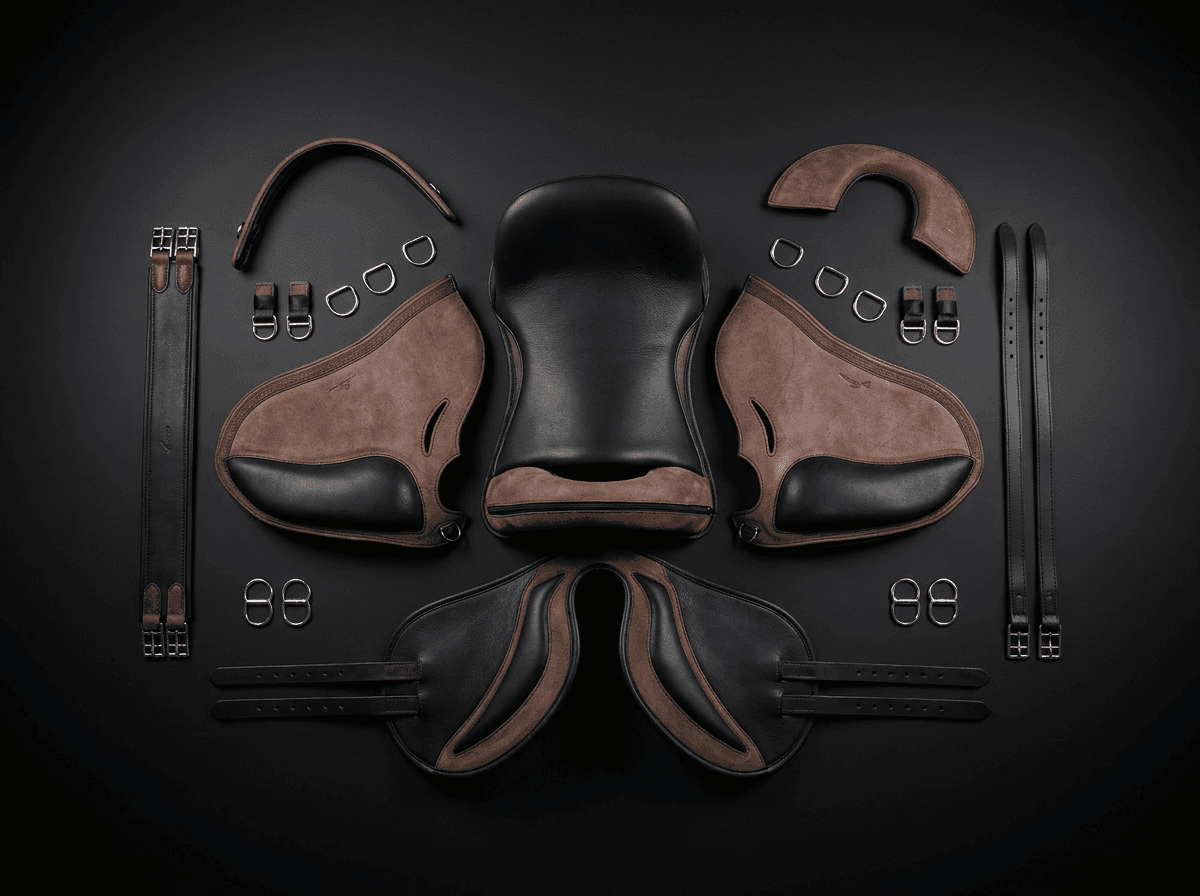
A horse's back is not a fixed measurement: it changes with the work, the season, the age and the workload. The Freeform is built to follow those changes, and it does so through the panels and the felt shims that slot into their pockets.
Adjusting does not mean filling: it means making up the hollows where the back has lost substance, and leaving everything else exactly as it was.
- 1
Read the sweat pattern
After a real working session, take the saddle off and photograph the pad straight away. The print is the most honest map there is of how you are loading the back: you want it even on both sides, with the central channel dry.
- An even, symmetrical print: nothing needs doing
- Isolated dry patches within the print: a pressure point
- No print through the middle section: the saddle is bridging
Sweat pattern on a saddle pad after work - 2
Open the panel pockets
Turn the saddle over and open the panel closures. The pockets are independent left and right precisely so that asymmetries can be evened out: always work one side at a time, and write down what you put where.
Panel pockets opened on the underside of the saddle - 3
Add shims where they are needed
Add one shim at a time, in the area that is carrying too little, then try again. One change at a time is the only way to know which one worked. Shims always go in flat, with no folds, pushed right to the bottom of the pocket.
Never stack more than two shims in the same area: past that you are concentrating the load rather than spreading it.
Sliding a felt shim into the panel pocket - 4
Judge it under saddle, not just from the ground
An adjustment is judged under load. Tack up again, work for ten minutes in all three gaits and read the print again. Go by feel as well: a well-adjusted saddle stays put without the girth being tightened beyond what is needed.
Rider in trot checking the panel adjustment - 5
Check again at every change of condition
Coming back into condition after the winter, a step up in workload, a return from a lay-off, a change of saddle for the horse: all of these are moments when the adjustment needs checking again. Keep a record — a photograph of the print and two lines of notes at each check are enough.
Do
- One change at a time, then try again
- Working the two sides independently
- Photographing the sweat pattern at every check
Don't
- Stacking shims to make up for a badly placed saddle
- Adjusting the panels cold, with no ridden trial
- Using shims that are wet or folded
Questions about this guide
Always start again from the placement: if the saddle is too far forward, or the channel is closed, no shim is going to solve it. Only once the placement is right does it make sense to work on the padding.
Evening out a small asymmetry with shims is normal, and it is one of the reasons the pockets are independent. If the asymmetry is marked, though, or has appeared suddenly, the saddle is not the answer: have the horse assessed.
Still unsure?
Send us a photo: we'll look at your case and tell you how to proceed.
Carry on with
Riding
How to position a Freeform on your horse
With no rigid tree, placement makes all the difference: where to set it down, how to free the spine and how to check the fit before you mount.
Safety
The safety checks before every ride
Thirty seconds on girthing, stirrups, Velcro and stitching: what to look at, what never to let pass and when to stop.